
Drones are of course, remotely controlled and modern ships are also chip-driven.

Lawyer: 'Did YOU not ever feel scared?' Shyamvar Rai: 'I am a driver, I said okay. Madam said it is your job...'

A doctor who treated Ebola patients in Guinea and returned to the United States last week has tested positive for the Ebola virus, becoming New York city's first diagnosed case.

Indians may adopt wait-and-watch policy in first year.

Here's a glimpse of Modi's first day in Israel.

Like China, India needs to encourage 'hacker clubs' in view of the challenges of virtual terrorism, says Lieutenant General Prakash Katoch (retd)

'The main meal consisted of one soup, a salad, 2 or 3 vegetarian dishes (including at least 1 green vegetable), a variety of rice, freshly prepared Rotis or Phulkas, Dal, and yogurt.'

A K Bhattacharya digs into the yet-to-be-public report on ways to curb black money and finds out that Modi's next moves could include action on dabba trading, hawala, and education.

Modi's visit to some developed countries such as the US, Japan, China and Australia were sprinkled with humongous investment figures. But do we have the wherewithal to absorb such big investments?
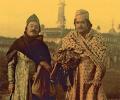
From Pakeezah to Ladies vs Ricky Bahl, from Shatranj ki Khilari to Umrao Jaan, the great city of Lucknow has made its way to the wornderful world of Hindi films.


Indian diplomat Devyani Khobragade has moved a federal court here to dismiss the visa fraud case against her, saying there is lack of personal jurisdiction since she had been accorded full diplomatic immunity by the US Department of State.
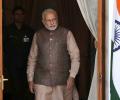
Ministers in the Narendra Modi government have been busy making presentations on their 100 days of work. But what these presentations do not mention is that decisions by ministers have been few, with plenty of papers and files moving to the Prime Minister's Office, which is increasingly emerging as a centralised clearance point, even for routine and ordinary issues. Though policy paralysis was a term used freely for the United Progressive Alliance regime, questions are now being raised about pending decisions across ministries and whether at least some ministers have turned redundant.

'A series of arrests have illustrated that IS now has a footprint in India.' 'India has been, for a very long time, a key part of Al Qaeda's global jihadist ambitions.'

There is speculation that China released the White Paper on Tibet in a hurry after a Spanish court agreed to hear charges of genocide against former Chinese president Hu Jintao. Ajai Shukla reports

Dr Kalyani Gomathinayagam, a young Indian doctor who volunteered to spend four weeks in west Africa helping those suffering and dying of Ebola, speaks to Vaihayasi Pande Daniel/Rediff.com why she took on an assignment many would shy away from.

'A plausible American tactic,' Rajeev Srinivasan suspects, 'would be to try and prevent the BJP and Modi from coming to power by splitting the anti-Congress vote using the AAP, and in case that fails, to follow up with a Plan B to make India ungovernable, to create mass conflict through their agents.'

The chief of America's Federal Communications Commission is not a fan of net neutrality. So what's his vision of communications and digital policy in these times?

This cult of speed reaches its crowning glory during that peculiar Indian spectacle called medical camps. Medical camps are an activity in which doctors from cities travel to underserved areas, often on weekends, where the poor are then herded in hundreds for deliverance, photo-ops and freebies. In their more evolved form, there are surgical camps where bewildered and overawed patients are put onto operating tables and, much like an assembly line, a series of operations are performed in rapid succession. The surgical instruments are often magically sterilised in minutes between procedures, says Dr Sanjay Nagral.

'India has to judge what Pakistan says to us, not what they say to a domestic audience,' a source tells Sheela Bhatt/Rediff.com, explaining why India-Pakistan talks remain on track despite discordant noises from across the border.


Moving ahead with their new mantra -- Chalein Saath Saath: Forward Together We Go -- Prime Minister Narendra Modi and United States President Barack Obama on Tuesday vowed to deepen cooperation in every sector for the benefit of global stability and people's livelihoods over the next ten years.

This is the joint statement issued by the ministry of external affairs on the visit of US President Barack Obama to India.
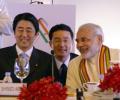
'Both nations have a common problem: A rampaging, jingoistic and hostile China which is making substantial territorial claims. In the long run, Japan and India are going to be the victims of Chinese aggression -- so they might as well hang together to contain China,' argues Rajeev Srinivasan.
